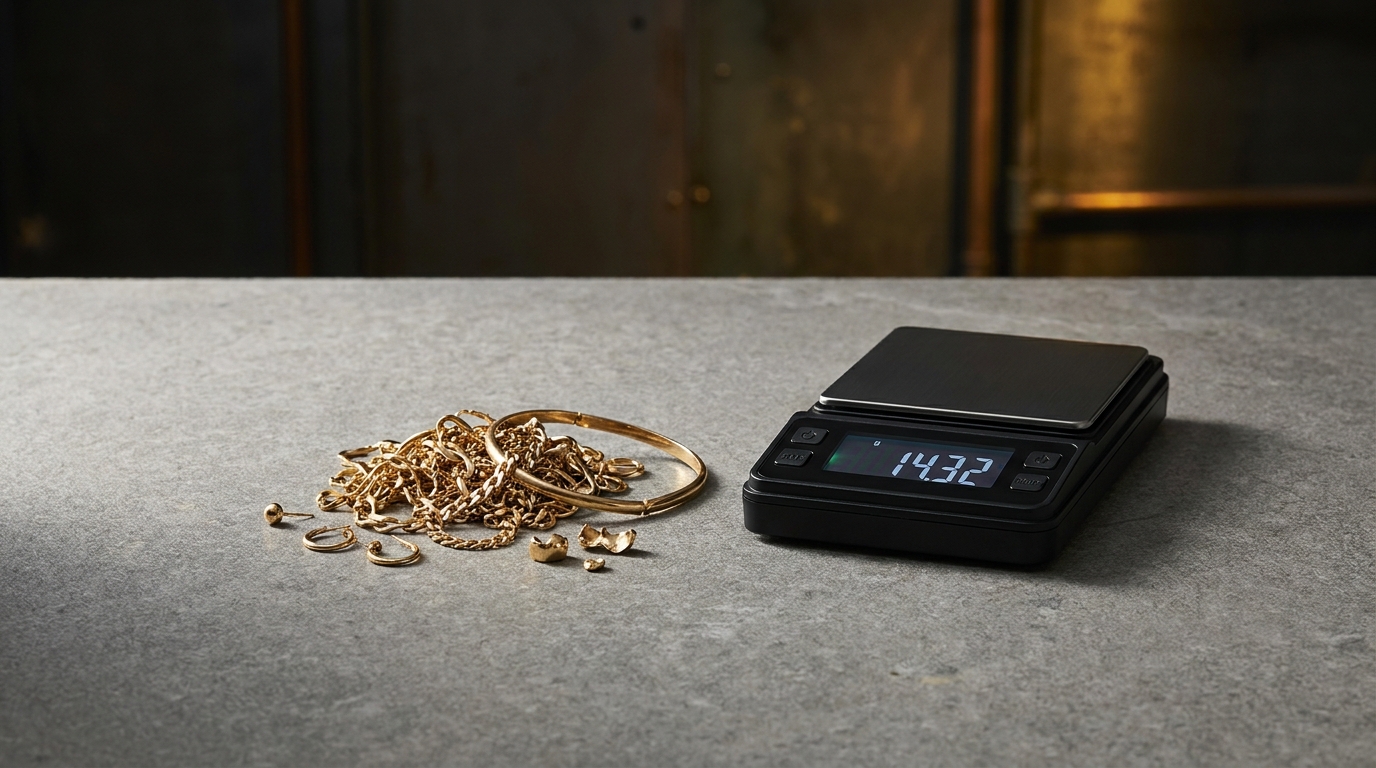
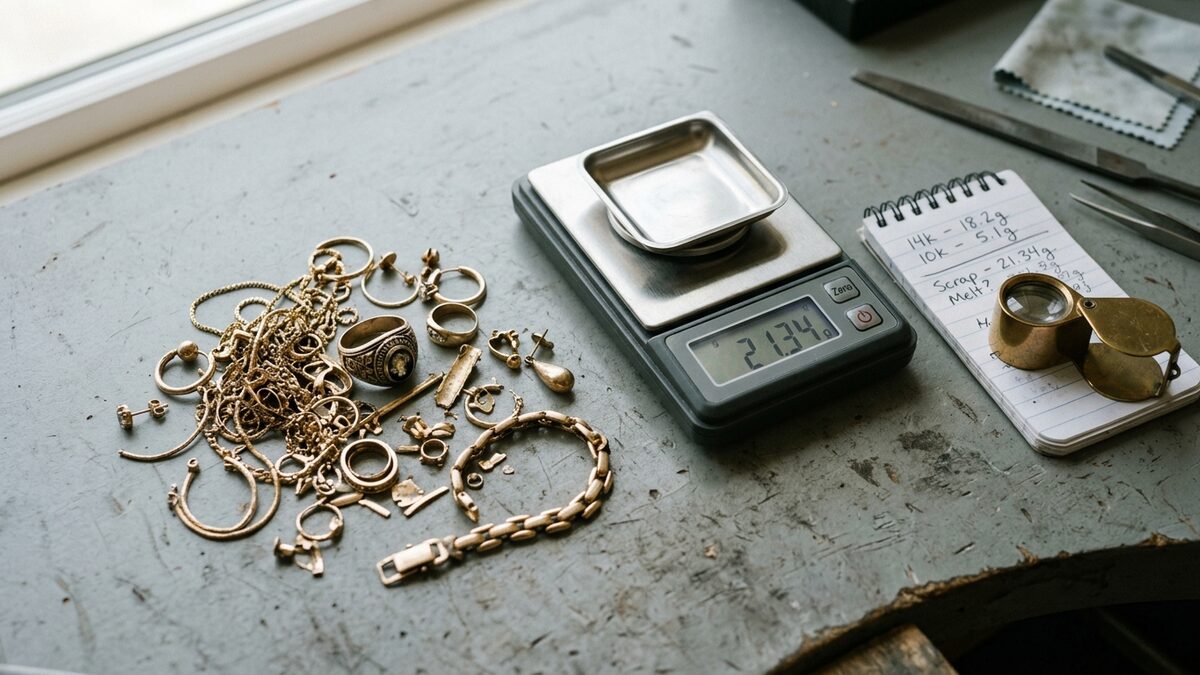
Most people who walk in with scrap gold have never sold any before. They have a baggie or a small dish: tangled chains, single earrings, a class ring, maybe a bent wedding band from a previous chapter. The question is always the same. What is this stuff actually worth? Here is the honest answer, in plain numbers, with no salesmanship.
Scrap gold is any gold item being sold for its metal content rather than its design, brand, or resale value as jewelry. A snapped 14k chain is scrap. A bent 10k charm is scrap. A solitaire ring with a worn-down shank and a small diamond is usually scrap on the metal side, with the stone evaluated separately. The piece does not have to be damaged to be sold as scrap; it just has to be priced on weight and purity rather than on what it looked like new.
Two numbers decide what you get paid: how much gold is in the piece, and what gold is trading for that day. Everything else is paperwork.
Karat is purity, and purity is most of the math
Karat tells you what fraction of the metal is actually gold. 24k is pure. 18k is 75 percent gold. 14k is 58.3 percent. 10k is 41.7 percent. The remainder is alloy metals like copper, silver, nickel, or zinc, which are essentially valueless at scrap volumes.
This is why a heavy 10k bracelet can be worth less than a thin 18k chain. The 10k piece is more than half not-gold. When a buyer weighs your items, the first thing they do is sort by karat stamp, because mixing karats during the weigh-in produces a number nobody can verify later.
Common stamps you will see: 10k, 14k, 18k, 22k, 24k, or the European equivalents 417, 585, 750, 916, 999. Items with no stamp are not automatically fake, but they have to be acid-tested or X-ray tested before anyone can quote a price. Reputable buyers will do this in front of you.
Weight is measured in grams, not what the jeweler told you
Gold is priced per gram or per troy ounce (one troy ounce equals 31.1 grams). Forget pennyweights and forget what the receipt said when the piece was bought. A calibrated gram scale on the counter is the only weight that matters for payment.
Stones, clasps that are not gold, and spring mechanisms get deducted or removed before the final weight. A ring with a 0.5 carat diamond will be weighed, the stone weight estimated and subtracted, and the remaining gold weight is what gets paid on. If the stone has its own value, that is a separate conversation and a separate line on the offer.
Turning karat and grams into dollars
Here is the rough arithmetic, using a hypothetical spot price of $2,400 per troy ounce, which translates to about $77 per gram of pure gold.
- 10k: 41.7 percent of $77, or about $32 per gram of item weight
- 14k: 58.3 percent of $77, or about $45 per gram
- 18k: 75 percent of $77, or about $58 per gram
- 22k: 91.6 percent of $77, or about $70 per gram
Those are the pure-metal values. No buyer pays 100 percent of pure-metal value, because the buyer has to refine the gold, cover overhead, and make a margin. Realistic offers from a fair buyer fall between 70 and 90 percent of the pure-metal value, depending on volume, karat, and how the buyer is structured. A pawn shop will typically pay less than a dedicated gold buyer, and a refiner who works directly with the public will typically pay the most.
So a 14k chain weighing 20 grams, on a $2,400 spot day, contains roughly $900 worth of pure gold and should produce an offer somewhere between $630 and $810. If a buyer offers you $300 for that chain, walk out.
What to expect when you walk in
A clean, well-run buyer's counter follows the same routine every time. Items get sorted by karat stamp. Anything unstamped or suspicious gets tested in front of you, usually with an electronic tester or an acid kit on a small scratch on an inconspicuous surface. Each karat group is weighed separately on a scale you can see. The buyer quotes the day's price per gram for each karat, multiplies, and gives you a single offer.
You are allowed to say no. You are allowed to ask what spot is today and check it on your phone (kitco.com is the standard reference). You are allowed to take your bag and go to a second buyer for comparison. Anyone who pressures you, refuses to show the scale, or quotes a single number without breaking down the karats and weights is not a buyer you should be doing business with.
Bring a photo ID. State law in most places requires the buyer to record ID and hold the items for a short period before melting, which is a consumer-protection rule and a sign you are dealing with a licensed operation rather than a back-room cash trade.
What is not scrap
Some items are worth more intact than melted. Signed designer pieces from established jewelry houses, vintage watches with intact movements and dials, gold coins (especially pre-1933 US coins, sovereigns, krugerrands, maple leafs, and any numismatic-grade piece), and antique jewelry with documented provenance can carry significant collector premiums above scrap. A buyer who knows the trade will flag these and offer you a choice: scrap price now, or consignment for a higher number later. If a buyer melts a coin without telling you, that is malpractice.
For the baggie of broken chains and single earrings, though, scrap is exactly the right call. You are not losing sentimental pieces by melting items you were never going to wear again. You are converting dead weight in a drawer into spendable money at a rate that, in 2026, is the highest it has been in living memory.
Walk in with realistic expectations, ask for the karat-by-karat breakdown, and compare offers from at least two buyers before you commit. That is the entire playbook.