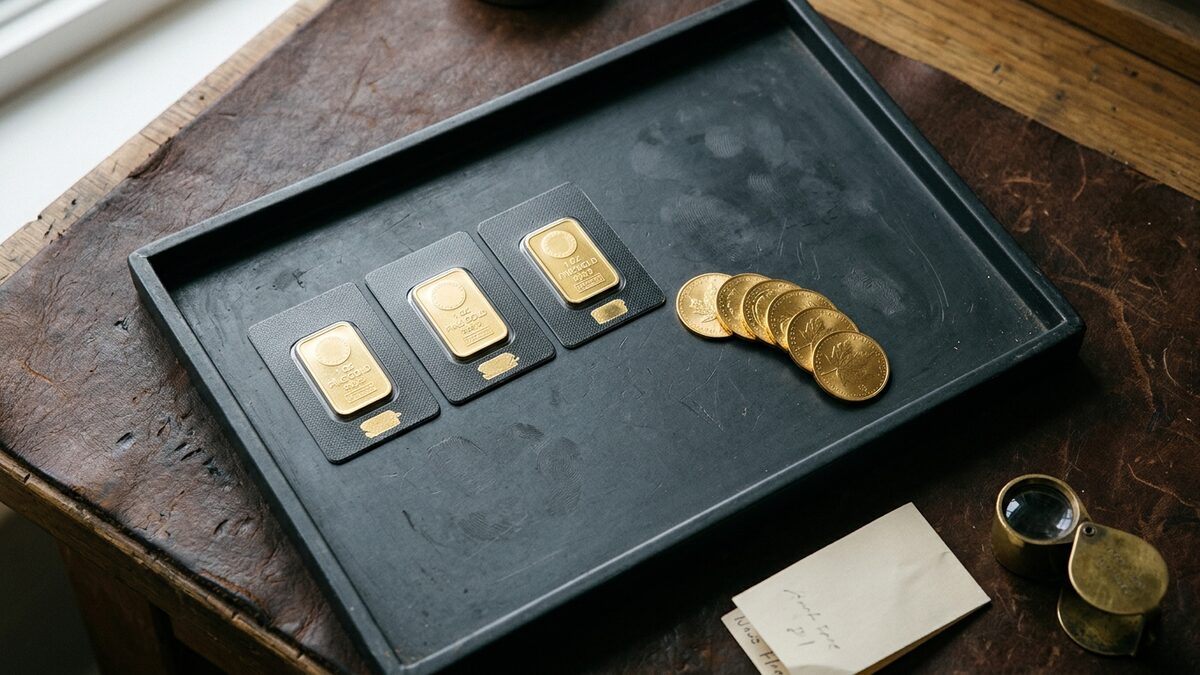
Spot price is the starting point, not the ending point. Every gold transaction has a premium above spot when you buy and a discount below spot when you sell. The size of that round-trip spread is what determines how much of your original purchase you actually recover. Bullion bars and sovereign coins behave differently in both directions, and the format you chose at purchase locks in most of your outcome before you ever shop the sale.
Bullion bars, particularly one-ounce and ten-ounce poured or minted bars from recognized refiners like PAMP, Valcambi, and Perth Mint, typically carry the lowest premium when you buy. A one-ounce bar might run two to four percent over spot. A ten-ounce bar tightens that further. Kilo bars are tighter still. When you sell those same bars back to a dealer, the buy-back offer usually lands within one to three percent of spot, assuming the bar is sealed in its assay card and the serial number is intact. A bar pulled from its assay, scratched, or showing handling marks gets treated like generic gold and pays accordingly.
Sovereign coins behave differently. American Gold Eagles, Canadian Maple Leafs, and South African Krugerrands all carry higher premiums at purchase, often five to eight percent over spot for current-year one-ounce pieces. The trade-off is liquidity. Every coin shop in the country recognizes a Maple Leaf. Buy-back offers on common-date Eagles and Maples in 2026 typically sit at one to three percent under spot for clean pieces. That is meaningfully better than the bar discount on a percentage basis, but the higher entry premium means the round-trip math often favors bars for pure investment holdings.
Where coins quietly outperform on the sell side
The exception is fractional gold. Quarter-ounce and tenth-ounce Eagles and Maples carry steep premiums at purchase, sometimes ten to fifteen percent over spot. Most sellers assume that premium evaporates entirely on the sale. In practice, dealers who serve retail buyers will pay a modest premium back, because fractional gold moves quickly off their shelves to walk-in customers who want a small piece without committing to a full ounce. If you bought fractional coins five years ago, the recovered premium can soften the round-trip hit considerably.
Pre-1933 US gold coins, British Sovereigns, and older European pieces fall into a separate category entirely. These trade on numismatic factors layered on top of metal content. A common-date Saint-Gaudens double eagle in average circulated condition pays a premium over its 0.9675 ounces of gold because it is a recognizable, collectible piece. Conditional grades from PCGS or NGC drive that premium higher. Selling these through a generic gold buyer leaves money on the table. They need to go to a coin dealer who actively trades numismatic gold.
Generic and off-brand bars are where sellers get hurt most often. A bar from an unfamiliar refiner, or a bar with no assay card, gets melted regardless of its actual purity. Dealers pay melt-minus on these pieces because they have to assume the worst and either refine the bar themselves or sell it to a refiner at a discount. If you have unbranded or unassayed gold, expect offers in the eight to fifteen percent below spot range.
What dealers actually prefer to buy in 2026
Dealer preference shifts with inventory needs and the current retail demand cycle. In 2026, with spot prices elevated and retail interest steady, the strongest buy-back offers we see consistently go to sealed Valcambi and PAMP one-ounce bars, current-generation American Gold Eagles, and Canadian Maple Leafs from the last decade. These pieces sell back through the dealer's retail channel within days, so the dealer can pay closer to spot and still maintain margin.
Older or damaged pieces, generic bars, and uncommon foreign coins move slowly. Dealers price those offers defensively because they may sit in the case for months or get sent to refining. If you are selling a mixed lot, separating the easy-to-resell pieces from the melt-grade pieces before you shop the sale lets you collect better pricing on the strong pieces rather than letting the dealer blend everything into one weighted-average offer.
The practical takeaway: if you are sitting on a position you plan to hold for years and eventually sell, bars from recognized refiners give you the tightest round-trip spread. If you bought coins, hold them in original packaging or capsules, keep any assay paperwork, and shop two or three dealer offers before committing. Fractional coins recover better than most sellers expect. Generic and unassayed bars recover worse. Numismatic gold belongs at a coin dealer, not a gold buyer.
Bring photo ID, know the current spot price the morning you walk in, and ask each dealer for their buy-back percentage of spot rather than a flat dollar figure. That single question makes the offer comparable across shops and across formats.