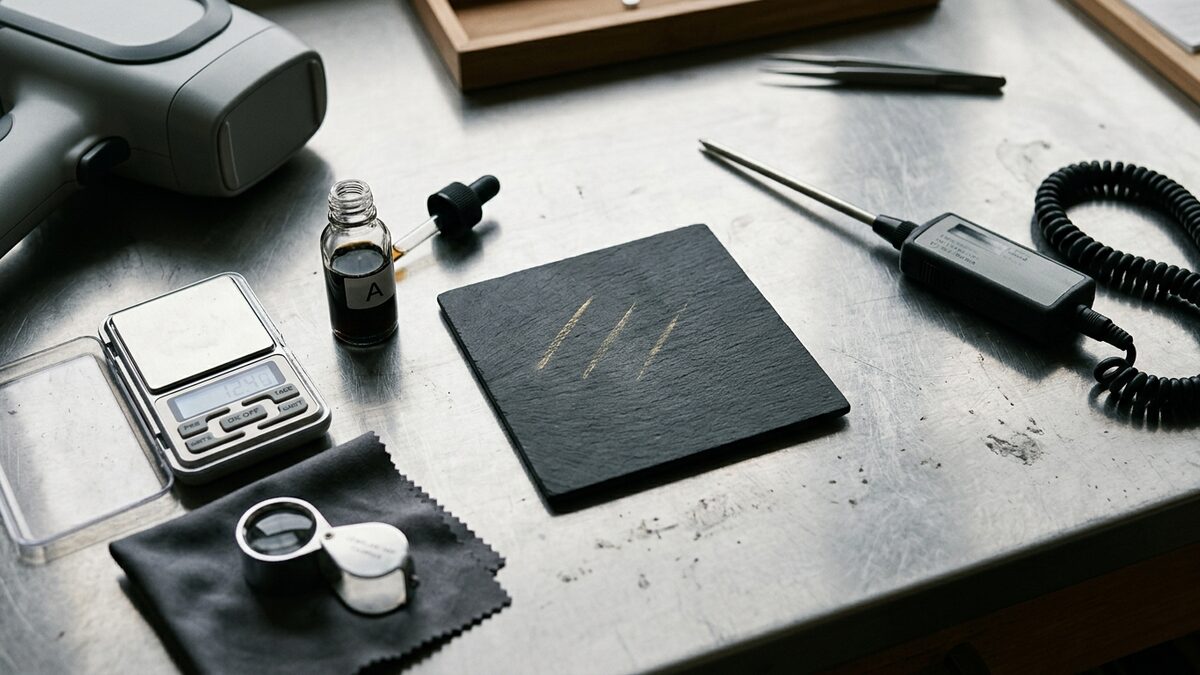
Gold is priced per gram of pure metal. A 14k chain and a 22k bangle of identical weight are worth very different amounts, so before a buyer can write a number on a slip, they have to answer two questions: how much does this piece weigh, and what percentage of that weight is actually gold. Weight is the easy part; a calibrated jeweler's scale handles it in seconds. Purity is where the real work happens, and where sellers lose money when they don't know what to look for.
There are four tests in common use at reputable buying counters in 2026. A careful buyer will run at least two of them on anything worth more than a few hundred dollars, and all four on heavier pieces or anything unmarked. You should be able to see every step.
The four tests, in the order a buyer typically runs them
The first test is the visual hallmark check. The buyer pulls out a loupe and looks for stamped karat marks: 10K, 14K, 18K, 22K, 24K, or the European equivalents (417, 585, 750, 916, 999). They also look for maker's marks and country-of-origin stamps, because some marks have known reputations for accuracy and others are routinely overstated. A hallmark is a starting point, not proof. Counterfeit stamps exist, plated pieces get stamped, and some legitimate older jewelry was never marked at all. Any buyer who stops here is not doing their job.
The second test is electronic conductivity, usually with a handheld unit that touches a probe to the metal and reads a karat estimate in a few seconds. These devices measure how electricity moves through the alloy and infer purity from the result. They are fast, non-destructive, and good enough to flag obvious fakes or heavily plated pieces. They are not precise enough on their own for a final offer, especially on white gold or pieces with surface treatment, but they are the right second step.
The third test is the acid-on-touchstone method, which has been the trade standard for over a century and is still in routine use because it works. The buyer rubs a small streak of the piece onto a flat black stone, then applies drops of nitric acid calibrated to specific karat values. The streak's reaction tells the buyer what karat the surface metal is. This test is mildly destructive in the sense that it leaves a tiny mark on the stone, not the jewelry, and on the jewelry only a streak that wipes off. A seller should expect to see this happen at the counter, not in a back room.
The fourth test, and the most accurate one available outside a refinery, is XRF spectroscopy. An XRF gun fires low-energy X-rays at the surface of the piece and reads back the exact elemental composition: gold, silver, copper, palladium, nickel, trace metals. A good XRF reading takes about thirty seconds and produces a printable report. The machines cost a buyer anywhere from eight to twenty-five thousand dollars, which is why not every small shop has one, but any buyer handling volume should. If you are selling more than a few ounces, ask whether they will run XRF; if the answer is no, that is information.
What to ask, and what to watch for
Ask the buyer to weigh each piece separately and write down the weight in grams. Mixed-karat lots get averaged in ways that almost always round against the seller. Ask which tests they plan to run, and ask to watch. A buyer who is comfortable with their offer has no reason to test out of sight. If the buyer uses XRF, ask for a printed reading. If they use acid on a touchstone, watch the streak go on and the acid go down; you will learn more in thirty seconds of watching than from any sales pitch.
Finally, ask what percentage of the daily spot price they pay. The honest answer in 2026 is usually somewhere between 70 and 90 percent of spot for scrap-grade gold, depending on the buyer's volume, the piece's karat, and whether the buyer is a direct refiner or a middleman. Anyone quoting a flat dollar amount without showing you the math is selling you something other than a fair price.
The right buyer welcomes the questions. The wrong one gets defensive. That is usually all you need to know.