Selling Gold in Tampa, FL: Sales Tax & Dealer Rules
If you are selling gold in Tampa, the sales-tax rules that made news in 2025 mostly affect buyers, not you. What matters more at the counter is Florida's secondhand-dealer law: the ID, the thumbprint, the holding period, and who gets a copy of your transaction. Here is the specific version.
The 2025 tax change, and why it barely touches sellers
Florida's bullion exemption sits in §212.08(7)(ww), Fla. Stat., created in 1999. For years it carried a catch: gold, silver, and platinum bullion — bars, ingots, or plates sold by weight under Florida Administrative Code Rule 12A-1.0371 — was only exempt when a single transaction's total sales price exceeded $500. That $500 threshold for bullion was eliminated effective August 1, 2025 by House Bill 7031, signed by Governor Ron DeSantis. All qualifying bullion is now exempt regardless of the transaction amount.
That is a buyer's benefit. Sales tax is charged when you purchase metal, not when you sell it back. As a seller, the practical takeaway is narrower: if a dealer in Tampa quotes you numbers, sales tax should not be quietly shaving your payout. If it appears on a sell-side ticket, ask why.
Two exceptions are worth knowing because sellers sometimes misjudge them. The $500 line still applies to certain coins that are neither bullion nor U.S. legal tender — a South African Krugerrand sold on its metal content, or world and ancient coins. And finished jewelry is taxed regardless, classified as tangible personal property because it is not sold primarily for bullion value. See our notes on selling coins and bullion versus selling jewelry for how that split changes what you carry in.
One local number: since June 1, 2025, dealers in Hillsborough County (Tampa's county) collect a combined 7.5% rate. That figure has moved around — it reflects a temporary reinstatement of two 0.5% surtaxes after a November 2018 transportation surtax was ruled unconstitutional.
The dealer rules you will actually meet
Florida regulates gold buyers as secondhand dealers under Chapter 538. Expect the following in Tampa.
- ID and a thumbprint. Under §538.04, the dealer takes your right thumbprint, free of smudges, plus a government-issued photo ID such as a driver license or military ID. The record notes the ID type, issuing agency, and number.
- Your sale is reported. Dealers file the transaction form with local law enforcement; older statute text set a 24-hour reporting window. The forms are approved by the Florida Department of Law Enforcement (FDLE).
- Lying is a felony. Under §538.04, knowingly giving false verification of ownership or false or altered ID and receiving money is, where the value is under $300, a third-degree felony. Bring metal you actually own, with clean ID.
None of this is unique to any one shop. It is state law, and a Tampa buyer who skips the thumbprint is out of compliance — a reason to be wary, not relieved.
Holding periods
Under §538.06, a walk-in secondhand dealer may not sell, alter, or dispose of precious metal, a gemstone, or jewelry within 30 calendar days of acquiring it. Mail-in buyers run a shorter clock: §538.35 bars disposal within 10 calendar days after payment is issued, and records are kept at least two years. That window is your practical grace period. If you have second thoughts a week after a mail-in sale, the metal may still exist in original form — ask.
Before registering, a dealer must hold a sales-and-use-tax Certificate of Registration (Form DR-11) for each county where it buys secondhand goods. A legitimate Tampa buyer is registered in Hillsborough County; that is a fair thing to confirm.
The retiree-supply story is regional, not city
Tampa is often described as a place awash in estate jewelry. The city itself does not fit that picture. Per the 2019–2023 ACS 5-Year Estimates, Tampa's median age is 35.6, and its over-65 share is 13.19% — below the nationwide 16.84%. Tampa the city skews young.
The estate angle is a metro one. The Tampa–St. Petersburg–Clearwater metro held about 3.42 million people in 2025. A projection — an estimate, not a count — put the metro's 65-and-over population at 493,540 in 2010 rising to a projected 654,509 in 2020, a 32.6% increase. So the inherited-jewelry supply that feeds regional buyers comes from the surrounding counties, not downtown Tampa. If a buyer tells you the local market is flooded with scrap and therefore your gold is worth less, that reasoning does not follow — your payout tracks the metal, not local supply.
Before you sell
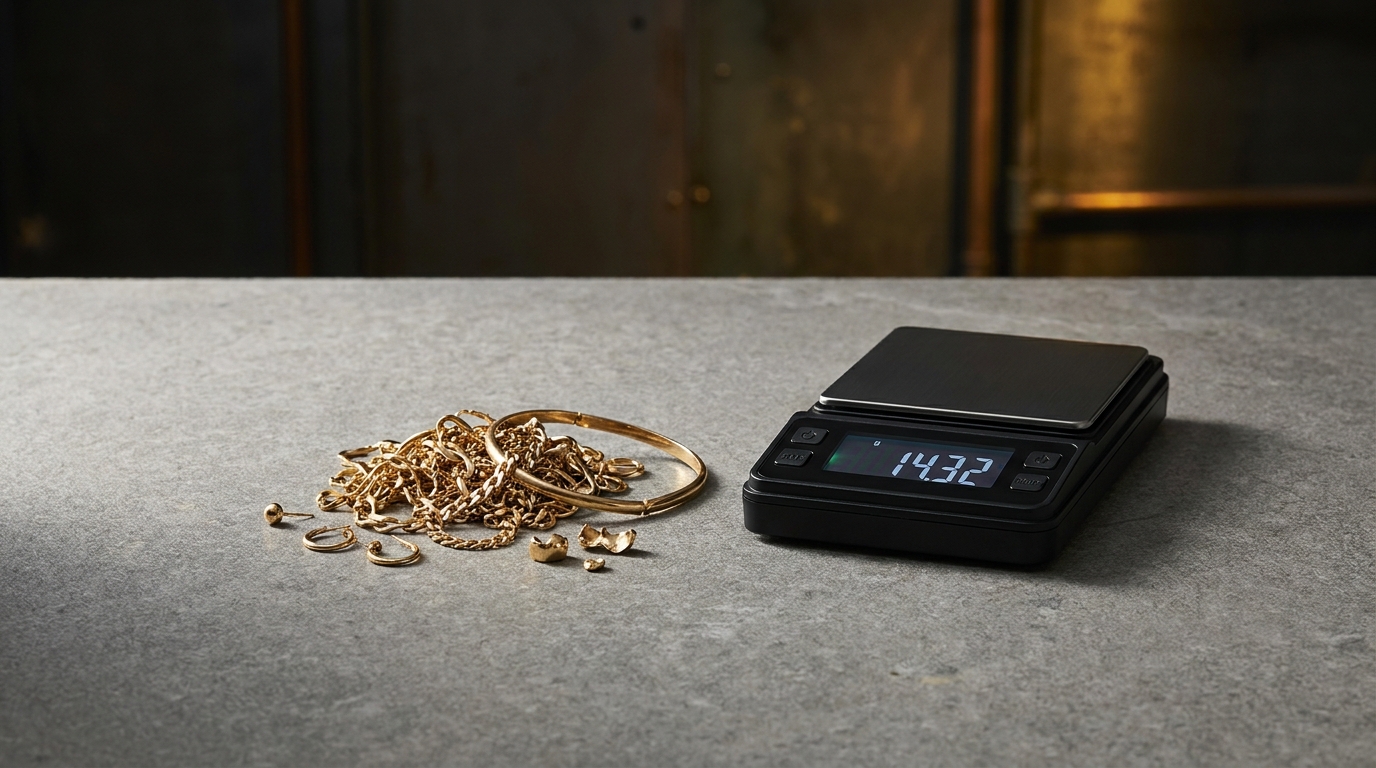
Weigh and note your pieces at home, separate anything that might be a collectible coin rather than melt, and check the day's gold price so a quoted offer means something. For mixed lots and worn jewelry, our scrap gold guide explains how weight and karat drive the number. Get more than one offer; the rules above apply at every registered shop, so shopping around costs you nothing but time.
Sources
This page is informational. Figures and rules cited are accurate as of the review date above and can change.
Last reviewed August 9, 2026.
Get a quote before you sell
Use the live calculator to see what your gold is worth at today’s spot price — weight, karat, and a real number, not a range.
Calculate now →