Should You Remove Gemstones Before Selling Gold?
Short answer: usually leave the stones in, unless they are valuable diamonds you can document. In that case, talk to a bench jeweler before you sell. Here is how to decide whether you should remove gemstones before selling gold jewelry.
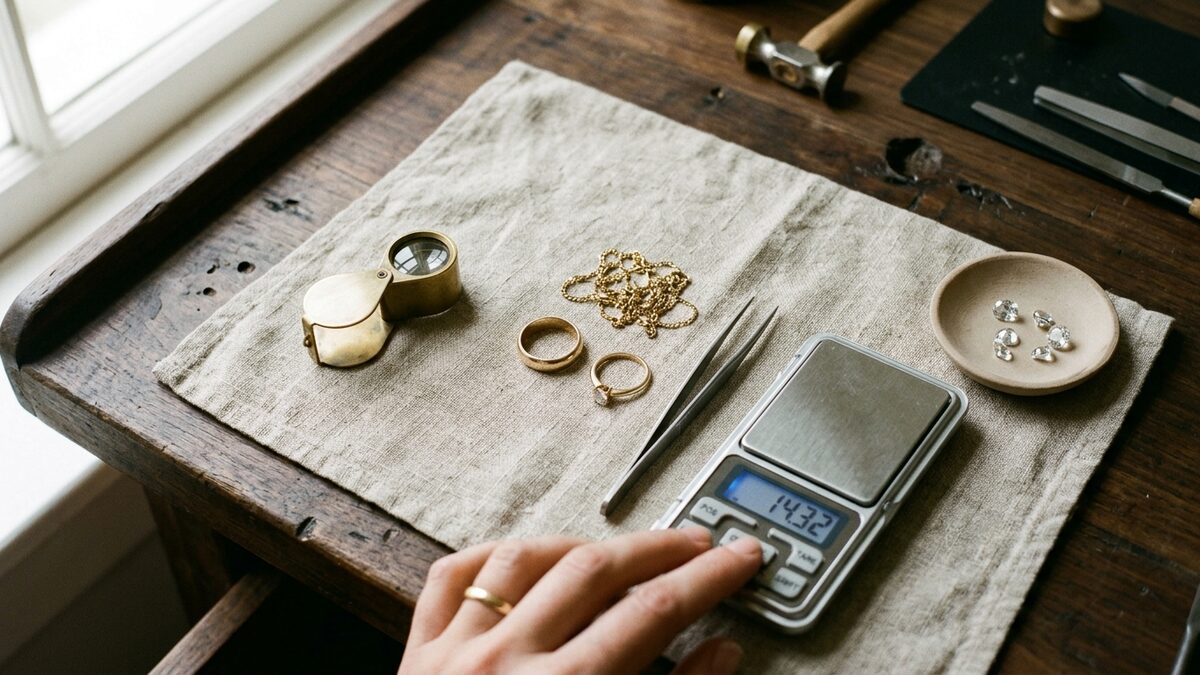
Start with how a gold buyer builds an offer. The price comes off the gold spot price, quoted per troy ounce of pure 24K gold, then gets scaled by karat: 18K is 75% gold, 14K is 58.3%, and 10K is 41.7%. The number that drives your payout is the weight of gold in the piece, multiplied by that purity and the live price.
That is where stones complicate things. A diamond or a colored stone adds weight to the scale without adding any gold. If you weigh a ring with a stone in it and punch the total into a calculator, you overstate the gold. A careful buyer accounts for this, and that adjustment is the real reason people ask whether they should remove gemstones before selling.
The other half of the story is that gems follow different pricing rules. Unlike gold, which has a daily spot price, gemstones are valued on several factors that take professional expertise to assess. A buyer pricing your ring by gold content is doing one job. A buyer pricing the stone is doing another. Sometimes the same person does both, and sometimes not.
Here is how the decision usually breaks down:
- Small accent stones: leave them in. Tiny diamonds or chips set around a center stone are rarely worth the cost of removal. Taking them out takes a jeweler's time, can mark or weaken the setting, and the stones are often worth little on their own. If the piece is going in as scrap, the buyer can account for them.
- A larger diamond you believe is high quality: consider removal, with a professional. A diamond marketplace makes the case that grading labs such as GIA grade only unmounted stones. Prongs and bezels can hide inclusions, metal color can reflect into the stone, and you cannot weigh a mounted diamond to learn its exact carat weight. If you have no grading report and think the stone is premium, getting it out and evaluated may be the only way to price it properly. Keep in mind that source sells diamonds, so weigh it accordingly.
- Colored and fragile stones: do not remove them yourself. Trade forum discussions warn that a jeweler's saw can chip or scratch an opal, and that opals can crumble if handled badly. If a colored stone matters to you, have a bench jeweler handle it.
- Sentimental or matched stones: if the stones mean something to your family, have them taken out for keeping before the metal is sold. Do that through a jeweler, not across a buyer's counter.
Why not just pull everything? Because removal is not free. Stones are held by prongs, bezels, or channels, and releasing them means cutting or bending metal. Done badly, you scratch a stone, chip its edge, or distort the setting. If the gold is headed for scrap, a bent setting costs you nothing. If the piece could sell as wearable jewelry, damage can cost you more than the stones were worth. A do-it-yourself attempt with a saw or pliers carries the same risk, and a slipped tool can ruin a stone that was worth more than the gold around it.
Removal also changes the paperwork. A piece with its stones in place can be inspected as a whole. A loose stone becomes a separate item that needs its own appraisal and its own buyer. That can be a good thing for one valuable diamond and a hassle for a handful of small ones.
Before you decide, ask every buyer the same questions. One jeweler's advice to sellers is to learn the process and know what questions to ask, otherwise you may get much less than the value of your gold. Good ones here:
- Do you deduct for stone weight, and how do you estimate it?
- Will you quote the piece with the stones in and, separately, the gold alone?
- How do you test the karat, and can I watch the weighing?
- Do you buy loose stones, or do I need a separate gem buyer?
- Is the offer final, or does it change after evaluation?
On our side, GetGoldValue lists gold and diamond jewelry among the pieces it buys, including rings, pendants, and bracelets with stones, along with broken pieces and old settings. The site also says the final offer comes after an in-person or mailed evaluation. It does not publish a rule for how set stones are handled, so call (213) 373-4424 with a description of your piece and ask before you remove anything.
A simple way to check any offer is to use the gold value calculator. Weigh the piece at home, subtract a reasonable guess for the stones, enter the karat and the remaining weight, and note the estimate. If an offer sits far below your gold-only figure, ask why. If a buyer cannot explain the gap in plain terms, get a second quote.
A short checklist before you sell:
- Read the karat stamp inside the band or on the clasp.
- Photograph the piece from several angles, including the stones.
- Weigh it at home and write down the total.
- Collect any grading reports, receipts, or appraisals.
- Get at least two quotes, and ask for the piece to be priced both ways.
The bottom line: leave small stones where they are, get professional help for anything valuable or fragile, and do not commit to removal until you know what a buyer would pay with and without the stones. The live spot price sets the base for your gold. Good questions protect the rest of the value.