How to Calculate Your Gold's True Cash Value Before Selling
Before you walk into a buyer's office, you should know — within a few percent — what your gold is actually worth. Here is the math, in plain English.
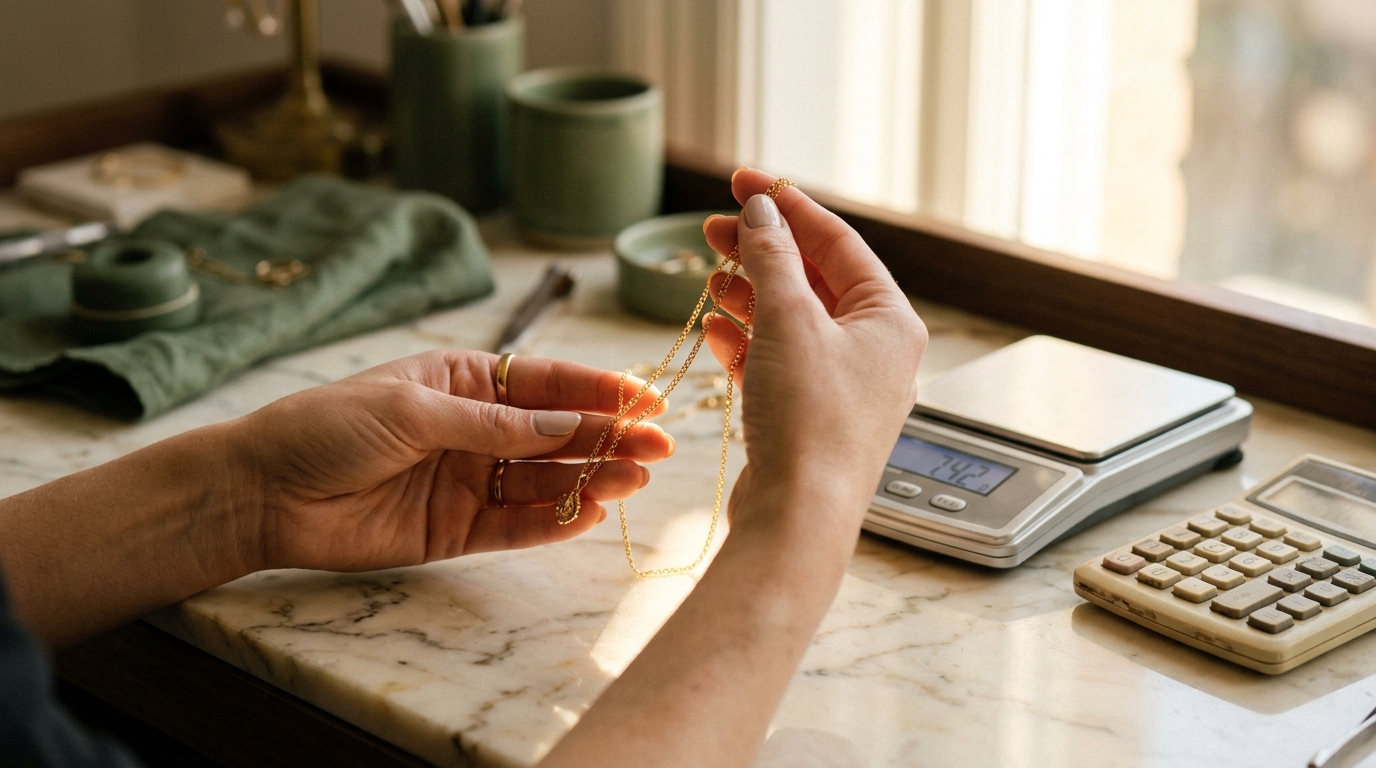
Most sellers walk into a gold-buying counter knowing only one number: the headline gold price they saw on the news. That number — usually quoted as $ per troy ounce — is the starting point, not the answer. Translating it into a real cash payout requires four inputs: purity, weight, live spot price, and dealer margin. Get any of those wrong and your estimate will be off by 20–40%.
This walkthrough is the same calculation our live calculator runs internally. Once you understand it, you'll know whether a buyer's quote is fair before you sign.
Identify the karat (purity)
Gold jewelry is almost never pure gold. Pure 24-karat gold is too soft to hold its shape, so it's alloyed with metals like silver, copper, palladium, or zinc to make it durable. The karat stamp tells you what fraction of the piece is actual gold:
- 24K — 99.9% pure gold (bullion bars, some coins)
- 22K — 91.7% gold (high-end jewelry, some coins)
- 18K — 75.0% gold (luxury rings, watches)
- 14K — 58.3% gold (most US engagement rings, chains)
- 10K — 41.7% gold (budget jewelry, class rings)
Look on the inside of a ring band, the clasp of a chain, or the back of a pendant. Common stamps include "10K", "14K", "585" (=14K), "750" (=18K), and "999" (=24K bullion). If a piece is unstamped, a buyer should test it with an electronic tester or acid kit before quoting — unstamped gold is not assumed to be gold.
Weigh the piece in grams
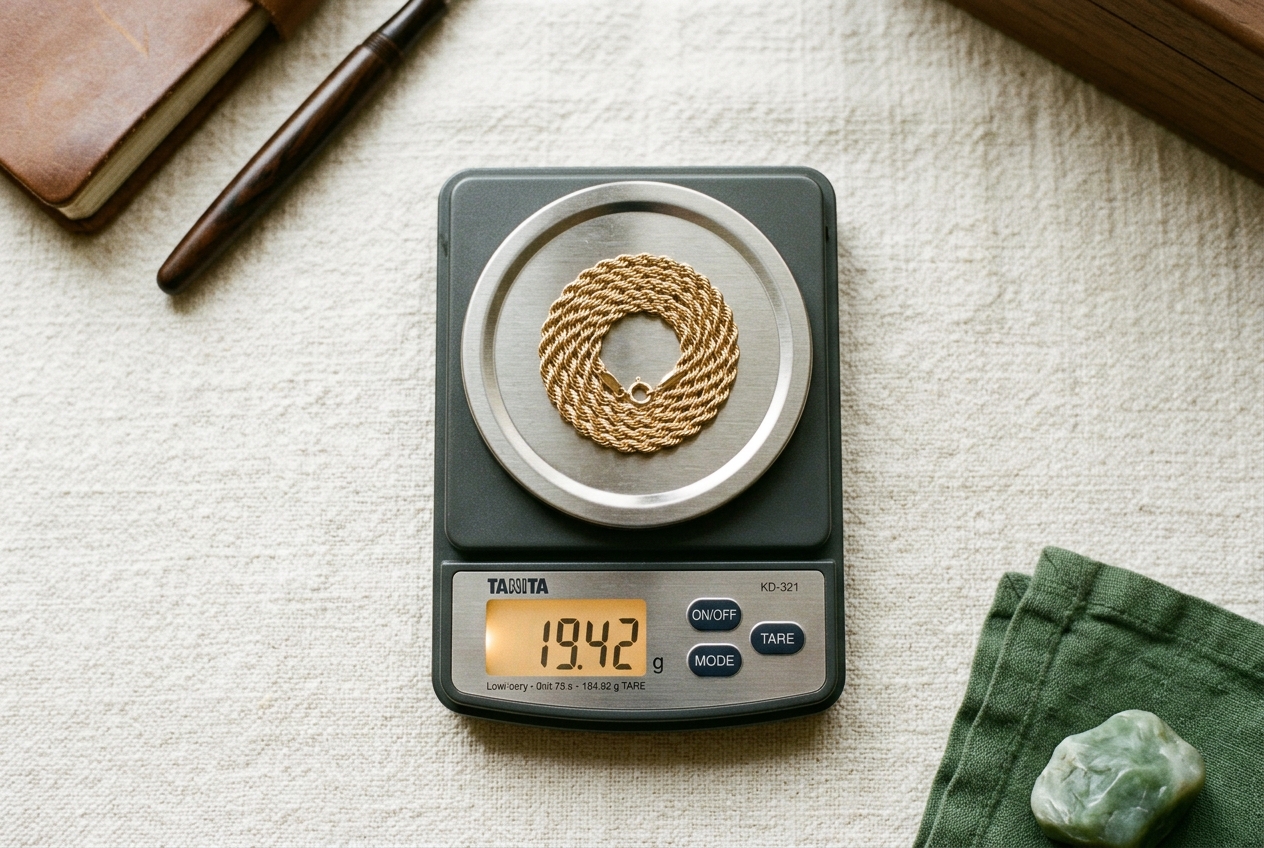
Gold is bought and sold by weight, and grams are the working unit at the dealer counter. A jeweler's scale that reads to 0.01 g is standard. Avoid kitchen scales: a 0.5-gram error on a chain stack adds up to real dollars at today's spot.
Two important things to remove before weighing:
- Stones. Diamonds, sapphires, opals — none of these are gold. Their weight should be excluded. A buyer either pops the stones out or estimates the carat weight and subtracts it.
- Non-gold parts. Spring clasps, watch movements, hollow bracelet beading filled with adhesive, and base-metal solder all skew the gross weight upward. Honest dealers show you the deduction in writing.
A typical 14K herringbone chain weighing 22 grams gross might net out at 19–20 grams of actual gold once stones and clasp hardware are removed.
Pull the live spot price
"Spot" is the wholesale price one troy ounce of pure (.999) gold trades for on global markets right now. It moves continuously during weekday trading hours and can shift several percent in a single day. The number you saw on Kitco at breakfast is not the number you'll be quoted at 3 PM.
To convert spot to a per-gram figure, divide by 31.1035 — the number of grams in one troy ounce. At a hypothetical spot of $3,200/oz, that's $102.88/g for pure 24K. That figure is the ceiling — what one gram of pure gold is worth in the global wholesale market.
Your jewelry isn't pure, so multiply by your karat fraction:
| Karat | Purity | Per-gram value at $3,200/oz spot |
|---|---|---|
| 24K | 99.9% | $102.88 |
| 22K | 91.7% | $94.34 |
| 18K | 75.0% | $77.16 |
| 14K | 58.3% | $59.98 |
| 10K | 41.7% | $42.90 |
Apply the dealer margin

This is the step everyone skips, and it's where most sellers feel cheated. No dealer pays 100% of spot. They are running a business — they need to refine, ship, hedge against price movement between purchase and resale, and turn a margin. A fair offer for jewelry-grade gold lands in the 85–94% of spot range, depending on quantity, karat, and the dealer's overhead model.
Walk-in pawn shops typically pay 50–70% of spot. Online "we-mail-you-an-envelope" services tend to land 60–75%. A licensed local precious metals dealer with low overhead and a refinery relationship can pay closer to 90%+. The difference on a 50-gram 14K piece is several hundred dollars.
Skip the math — let our live calculator do it.
Our free gold calculator uses live spot pricing and shows you exactly what we'd pay before you commit to anything. Enter karat and weight, get a number.
Calculate Now →Putting it all together — a worked example
Say you have a 22-gram 14K gold chain. The clasp is 0.6g of base-metal hardware. Today's spot is $3,200/oz.
- Net gold weight: 22g − 0.6g = 21.4 grams
- Per-gram 14K value at spot: $59.98/g
- Theoretical spot value: 21.4 × $59.98 = $1,283.57
- At a 90% dealer rate: $1,155.21
- At a 70% pawn rate: $898.50
That $250+ gap is exactly why understanding the math before you walk in matters. Selling gold jewelry at a fair rate isn't about haggling — it's about knowing what fair looks like.
What to bring when you sell
- Government-issued photo ID (legally required in California for any purchase over $100)
- The gold itself, separated by karat if possible
- Any receipts or appraisal documents — useful but not required
- A second opinion in your back pocket: at least one other dealer's quote
How accurate is your live calculator?
It pulls spot every few minutes from a wholesale market feed and applies our actual buy rate. The number you see is what we'd pay, not a marketing teaser.
Why does my appraisal say my ring is worth $4,000 but you're offering $1,200?
Appraisals are insurance replacement values — what a jeweler would charge to remake the piece retail. The cash-melt value is calculated from the gold weight only, ignoring labor, design, brand, and retail markup. Both numbers are real; they answer different questions.
Should I sell now or wait for a higher spot?
Spot moves both ways and timing it is hard. If you need cash now, the math above tells you whether today's quote is fair. If you can wait, watch the spot trend over a few weeks before you commit.
For more on how spot pricing actually moves and why dealer quotes change hour to hour, read our companion piece: Why Live Spot Pricing Matters When You Sell Gold.