How Gold Buyers Price Unmarked Gold Jewelry
No stamp on the clasp does not mean no value. A buyer can still test the piece, confirm the karat, and price it off the live spot price. Here is how that works, step by step.
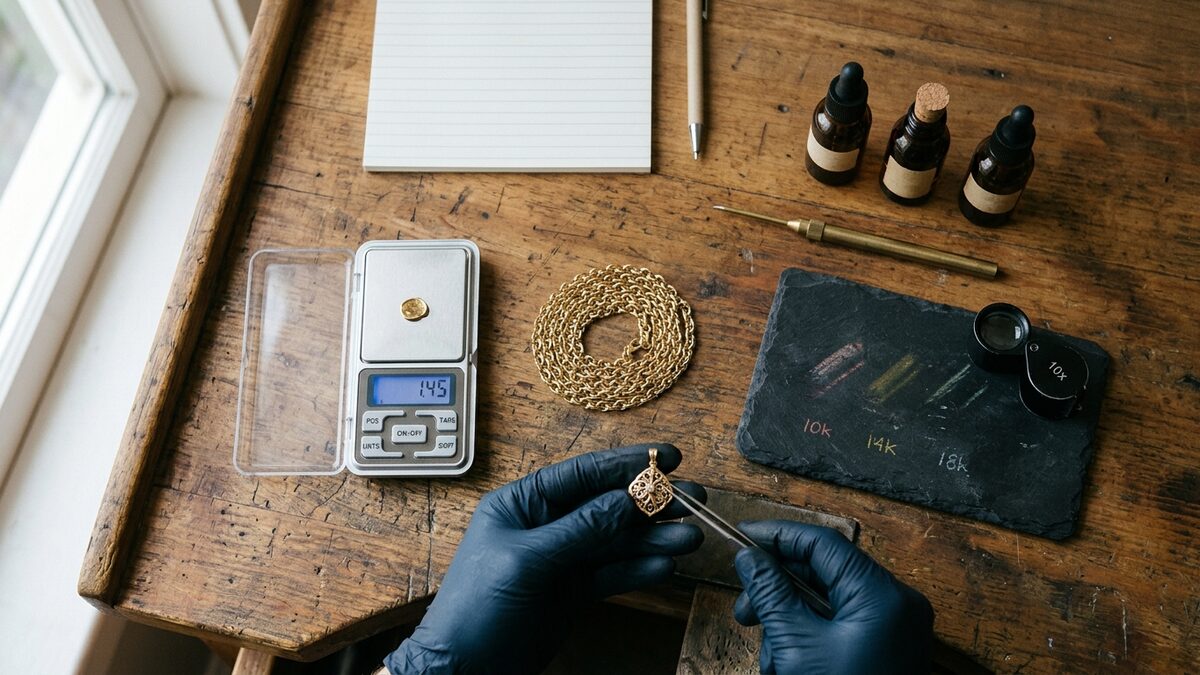
A missing stamp is common. Inherited pieces, custom-made jewelry, and items bought abroad often carry no hallmark, and some stamps are simply too worn or too small to read. A buyer treats that as a testing job, not a dead end. The piece still has gold in it; the only open question is how much.
Where a stamp exists, it is usually a number such as 375 (9K), 585 (14K), 750 (18K), or 999 (24K), and it gives the buyer a starting point. Without one, nothing is taken on trust. The buyer has to establish the purity independently, because purity is what sets the price per gram. Here is the sequence, in the order it normally happens.
- Weigh the piece. Weight is measured in grams or pennyweights (1 pennyweight is 1.55 grams). A troy ounce is 31.1 grams, which is the unit the spot price is quoted in. Weight alone tells you nothing about purity, which is why the next step exists.
- Test the purity. With no hallmark to read, the buyer checks the metal itself. Two common methods are the acid test, which judges purity by how a sample reacts to a reagent, and X-ray fluorescence (XRF), an electronic method that analyzes the metal's composition. Testing can add time to an evaluation, and a missing hallmark can lower a buyer's confidence in the piece until the result is in.
- Match the result to a karat. The reading is translated into a standard grade: 10K is 41.7% gold, 14K is 58.3%, 18K is 75%, 22K is 91.7%, and 24K is 99.9%. This is the number that replaces the missing stamp.
- Apply the live spot price. Melt value is the spot price per gram, times the purity percentage, times the weight. This is where the confirmed karat turns into a cash number.
- Make the offer. Buyers differ in how much of melt value they pay, so the number you are quoted depends on who you sell to as well as what you own.
Here is the math with a round-number spot price of $2,000 per troy ounce, used only to keep the arithmetic easy; the live price on any given day will differ. That works out to about $64.31 per gram of pure gold ($2,000 divided by 31.1). Take a 10-gram chain with no stamp:
- If testing says 10K: 10 grams times 41.7% is 4.17 grams of pure gold, worth about $268.
- If testing says 14K: 5.83 grams of pure gold, worth about $375.
- If testing says 18K: 7.5 grams of pure gold, worth about $482.
Same chain, same weight, same spot price, and the melt value moves by more than $200 depending on one test result. That is why a buyer will not quote a firm number until purity is confirmed, and why you should be cautious about any quote given on an unmarked piece before it has been tested.
Because the test result carries so much weight, it is fair to ask how it was done and to see the reading before you accept. A buyer who prices off the live spot price should be able to show you the karat, the weight, and the per-gram rate used. If those three numbers are on the table, you can check the math yourself.
You can also prepare before you go. Run the weight through a calculator at 10K, 14K, and 18K to see the range of outcomes, then compare it with the quote. If the offer sits at the low end of the range, ask what the test showed.
The price you receive depends on purity, weight, market value, and where you sell. Unmarked gold changes only the first of those: purity has to be proven rather than read. Weight and market price work exactly as they do for stamped jewelry, so the same live-spot logic applies once testing is done.
On its sell-gold-jewelry page, GetGoldValue says that not knowing your karat is fine because it tests every piece, and that every offer is tied to the live gold spot price. Its free calculator takes weight and karat and returns an estimate, and you can call (213) 373-4424 to ask how an unstamped piece would be handled.
In 2026, with spot prices moving daily, the sensible habit is the same: get the piece tested, get the karat and weight on screen or in writing, and price it off the same-day spot.