Does Damaged or Broken Gold Sell for Less?
A bent ring, a tangled chain, a single earring with no match: none of that lowers what the gold inside is worth. When you sell gold as scrap, you are selling the metal, not the object, and the scale does not care how the piece looks.
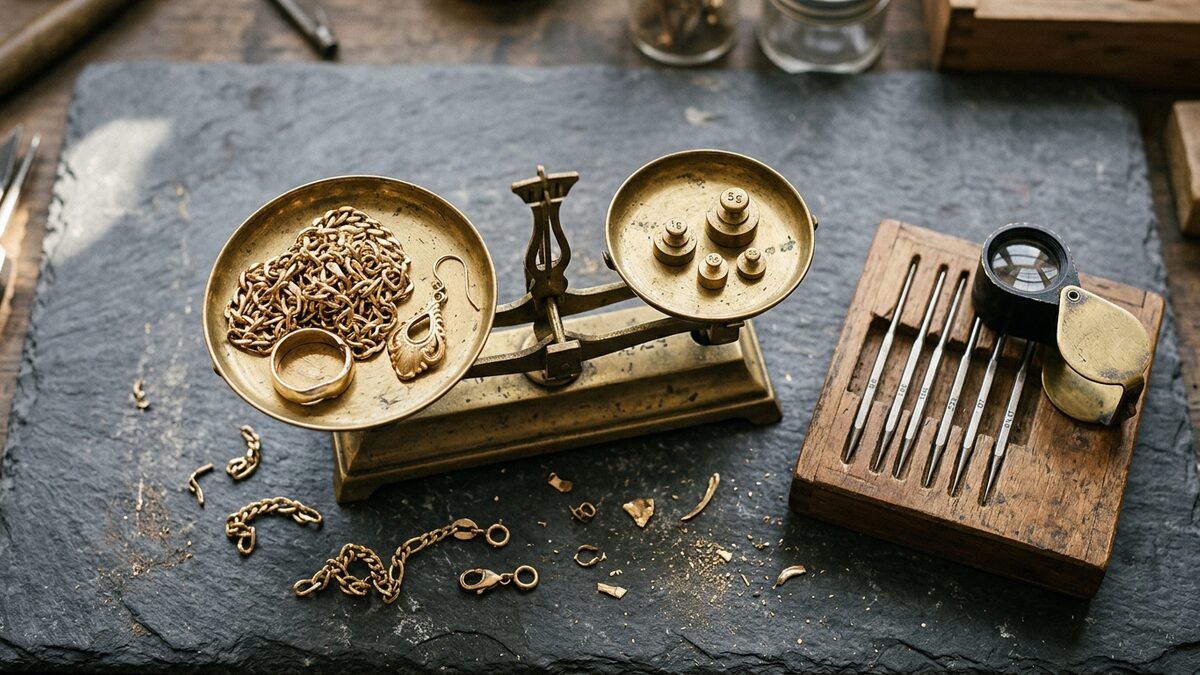
Here is the short answer most sellers do not expect: damage rarely costs you anything on a scrap payout. A reputable buyer weighs your gold, tests the karat, and prices it off the live spot market. A dent, a snapped link, or a missing stone does not change how many grams of gold are sitting on the scale. If the metal is there, the value is there.
The reason people assume otherwise is simple. When you buy jewelry, condition is most of the price. You pay for brand, craftsmanship, polish, and presentation, so it feels natural to expect the reverse at the counter. But a scrap buyer is not reselling your chain as jewelry. It goes to a refiner, gets melted, and the pure gold is recovered. At that point the clasp, the scratches, and whether a stone fell out years ago mean nothing to the final number.
Scrap gold is bought by weight and purity, not by looks
The math is straightforward, and there is no line in it for condition. Karat tells you purity: 14K is 58.3% gold, 18K is 75%, 22K is 91.7%, and 24K is pure. Your payout is the weight in grams, multiplied by that purity, multiplied by the live spot price, less the buyer's margin. Nothing about a bend or a scratch enters that formula. At GetGoldValue every piece is tested and priced off the real-time spot price, from 9K all the way to 24K.
In practice, broken gold is some of the easiest material to sell. Tangled or snapped chains, warped settings, bent bands, and odd single earrings are classic scrap. Nobody is going to wear them again, so there is no intact-jewelry premium to hold out for, and that premium never applied to a melt sale in the first place. Do not throw broken pieces in a drawer assuming they are worthless. They carry the same per-gram value as anything else at that karat.
What actually reduces a payout is non-gold weight, not damage. Steel clasps, spring bars in watch cases, stones, and solder get deducted because they are not gold, not because the piece is worn. Gold-plated items are a separate matter entirely: there is only a thin layer of gold over a base metal, so they pay very little. That is a purity reality, not a condition penalty. Hollow chains also weigh less than they look, so a big piece can come in lighter than you expect.
When condition can actually matter for the price
There is a real exception, and it is worth knowing before you melt anything. Some pieces are worth more intact than they are as metal. Collectible and numismatic coins are the clearest case. A pre-1933 US gold coin or a graded collector coin can trade well above its melt value, and on those pieces scratches, cleaning, or wear can genuinely lower the collector premium. Investment bullion is different again: because coins and bars have known weight and purity and need no refining, they typically earn a higher payout percentage than jewelry, starting at 90% of gold value for bullion and coins — or higher*.
*Payout percentage depends on gold content (karat/purity), item type, weight and volume, and is subject to change. Final offer after in-person or mailed evaluation.
The same logic applies to branded designer jewelry and antique pieces that still have resale value as jewelry above their gold content. If a piece is worth more whole than melted, condition clearly matters, because you are no longer in a scrap transaction. That is the one situation where it pays to have a buyer look at the item before anything is melted down. When in doubt, ask, and let the piece be evaluated both ways.
For everyday gold, though, the takeaway is clear: do not pre-sort, repair, or discard your broken gold before selling. Bring the bent rings, the broken clasps, the mismatched earrings, and the tangled chains all together. Weigh it, test it, and see the quote calculated off the live spot price in front of you. If you want a ballpark before you come in, run the numbers through the gold value calculator, and call the office to confirm the current rate and what you are holding.